

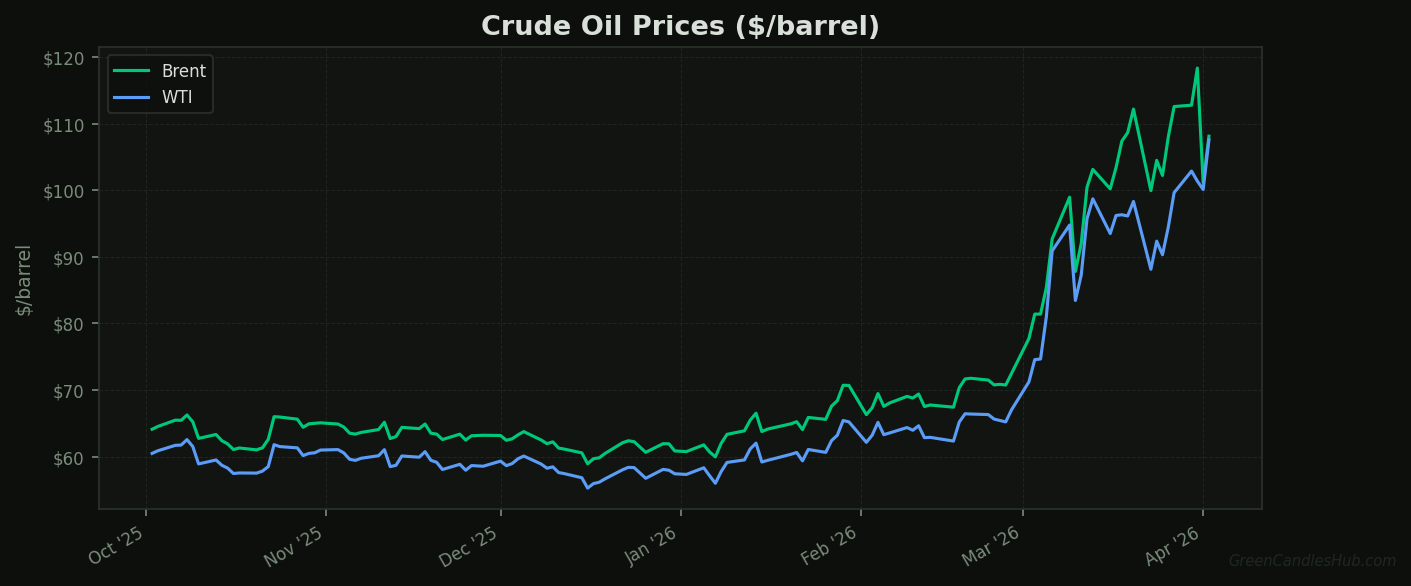
Iran’s Revolutionary Guard is charging $1 per barrel — payable in yuan or stablecoins — on tankers it selectively permits through the Strait of Hormuz, WION reported on April 2, citing shipping sources. At normal Hormuz throughput of 20 million barrels per day, that rate would generate $20 million in daily toll revenue from a single chokepoint. With WTI now above $105 and Brent at $107, the arithmetic rewards Iran for keeping the blockade running indefinitely.
The $1/barrel toll is a live test of whether a sanctioned state can monetise chokepoint control without touching the dollar system — and so far, it is passing.
The $1/Barrel Rate: Selective Access, Differential Pricing
The IRGC’s transit permission system is not random. Iran has explicitly labelled India a “safe” partner — Indian tankers receive access that others do not. That differential pricing creates a two-tier crude market where passage through Hormuz is itself a tradeable commodity, priced at $1/barrel above whatever the buyer is paying for the cargo. The geopolitical alignment required to unlock that discount is the real product being sold.
The revenue math works even at severely reduced throughput. Hormuz traffic has been at a near-standstill for over a month — ADNOC’s Group CEO publicly warned of the danger to global energy flows on April 2, describing Iran’s unilateral control over transit as a threat to the entire world economy. But even at 1 million barrels per day of actual transit — roughly the volume Venezuela shipped to India in March alone — the IRGC collects $1 million per day in foreign currency that bypasses the global banking system entirely. At 5 million bpd, that is $5 million daily. The toll scales with any future de-escalation agreement, which is why Iran has no incentive to fully reopen the strait for free.
Why Stablecoins? Iran Is Building Dollar-Proof Payment Rails
Iran has operated outside the dollar system for years under sanctions. What is new here is scale and deliberacy. Requiring stablecoins as a settlement medium for oil transit is the first documented case of a state actor mandating crypto payment at a strategic chokepoint — and the irony is structural. The likely instrument is USDT, a dollar-denominated stablecoin, being deployed to circumvent the dollar-denominated financial system.
Tether, the dominant stablecoin issuer with well over $100 billion in supply, has previously been pressured to freeze sanctioned wallets. The practical ceiling on that enforcement is how quickly IRGC-adjacent addresses can cycle through intermediary wallets to render blockchain forensics ineffective. Stablecoins have been moving toward mainstream institutional adoption — this development accelerates the regulatory urgency around issuers like Tether in ways that affect every holder of dollar-backed stablecoins.
The template is what matters most. Any future state actor controlling a chokepoint — a port, a pipeline junction, a canal — now has a working proof of concept: restrict access, price it in crypto, collect in yuan. The Hormuz toll booth is the first live demonstration that sanctions-resistant geopolitical leverage can be monetised in real time without a correspondent bank.
China Gets Cheap Oil and Yuan Payment Infrastructure Simultaneously
On April 2, Chinese officials ordered private refiners to maintain 2025 fuel output levels regardless of economic losses. A directive to absorb losses only makes operational sense if Beijing is securing crude at a price that compensates for the margin hit — which is what the yuan-denominated toll arrangement provides. Chinese refiners get access. They pay in yuan. Iran gets hard currency outside the dollar system. The arrangement suits both parties.
Bloomberg’s April 1 analysis framed China as the war’s strategic winner: positioning as the global responsible actor while locking in discounted crude and observing US military capabilities in a live theatre. Every barrel settled in yuan through Hormuz strengthens the PetroYuan argument. Saudi Arabia launched yuan-denominated oil trades with China in 2023. The UAE has been exploring similar arrangements. The Hormuz toll — if it continues — normalises yuan commodity settlement at the world’s most critical oil transit point.
Venezuela adds further evidence of the rerouting logic. The country shipped 1.09 million barrels per day in March — its highest in six months — with India absorbing most of the supply. India is simultaneously importing from Venezuela via the Atlantic and from selectively permitted Hormuz tankers at the $1/barrel toll rate. New Delhi is not fighting the IRGC pricing structure. It is operating within it.
The WTI +51% Move Was the Distraction — This Is the Signal
WTI jumped 51% in a single month — the largest monthly price climb since futures began trading on the NYMEX in 1983. Gasoline in the US topped $4 per gallon. Diesel sits at $5.50. These numbers dominate portfolio decisions and media coverage. They are real and they matter. But they are downstream of the structural shift: Iran has created a mechanism for commodity pricing that does not require SWIFT, does not require the dollar, and does not require any Western correspondent bank to process the transaction.
The global energy system is already repricing this disruption from Bangladesh to Zambia, where governments are rationing fuel and cutting subsidies as the Hormuz bottleneck cuts off supply. The oil price itself and the equity responses are all calibrated against the assumption that dollar-denominated settlement is the permanent baseline. The Hormuz toll booth is testing that assumption in real time, and no one on the options desk is pricing it yet. For an earlier analysis of how the Iran war has moved oil markets, see Iran War and Oil Prices: What Traders Need to Know.
Watch These Two Numbers Before May 1
The first metric is on-chain USDT transfer volumes to wallets associated with UAE and Iraqi Kurdistan addresses — the likely IRGC-adjacent geography for converting stablecoin tolls into usable capital. Blockchain analytics firms including Chainalysis and Elliptic track these flows in near real time. Rising volumes alongside sustained Brent prices above $100 would confirm the toll arrangement is scaling, not shrinking.
The second is open interest on Shanghai INE crude futures — the yuan-denominated contract launched in 2018 that has never displaced the dollar benchmark. Open interest has remained well below levels that would signal mainstream institutional adoption. If it surges materially before the first week of May, China has formalised yuan-denominated Hormuz crude as a structural feature rather than a wartime workaround. That is the signal that the stablecoin toll booth outlasts the war — and that the next chokepoint operator already has a playbook to copy.
Disclaimer: This article is for informational purposes only and does not constitute financial advice. Nothing here should be taken as a recommendation to buy or sell any security or asset. Always do your own research and consult a qualified financial adviser before making investment decisions.