
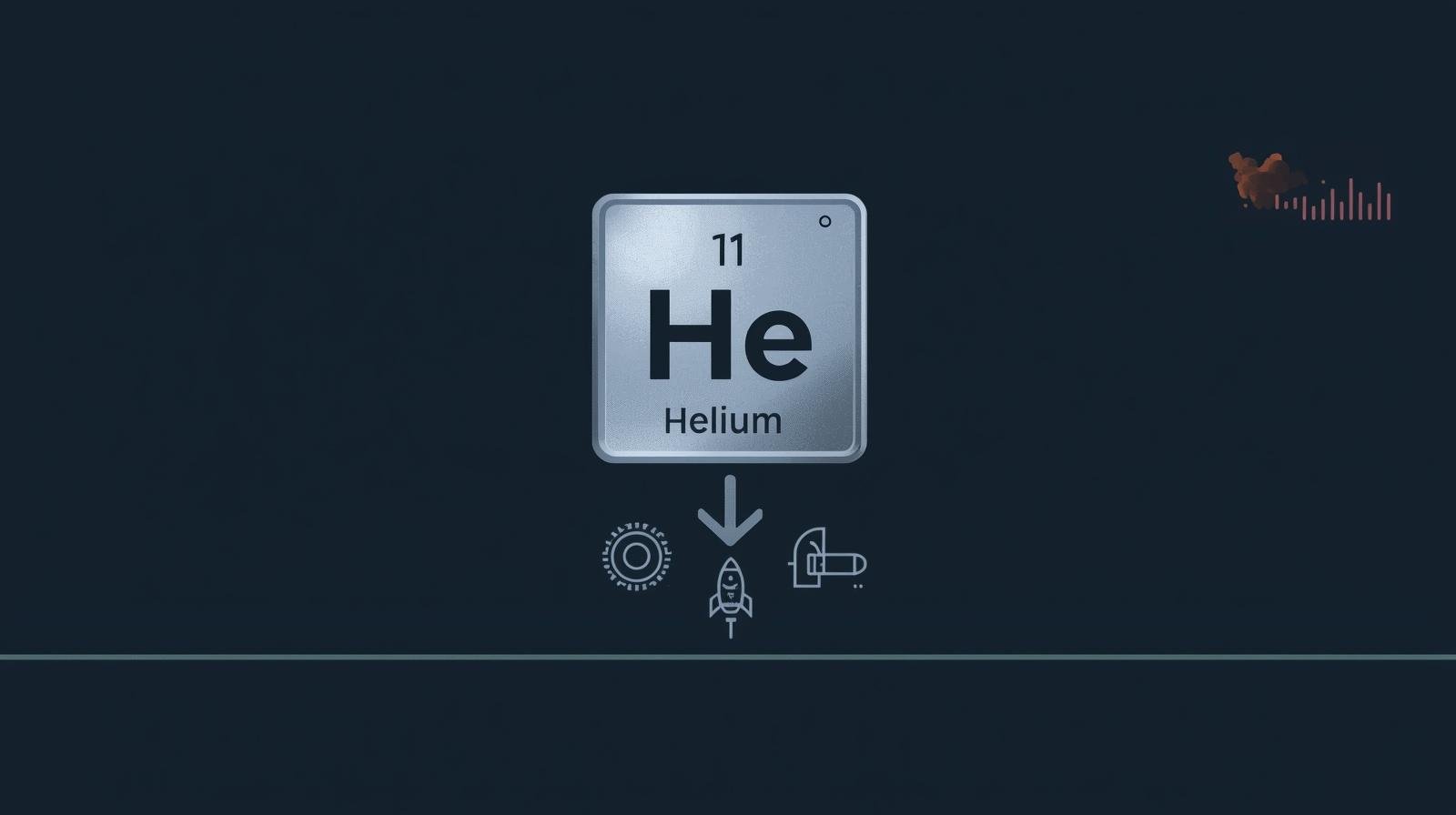

When Iranian strikes hit Ras Laffan in early March, QatarGas shut helium production immediately — not as a precaution, but because the infrastructure that liquefies natural gas and the infrastructure that captures helium are the same infrastructure. Within days, spot prices had surged 40–100% across different markets, and semiconductor supply chains in South Korea were running on stockpiles with no confirmed resupply date. Gulf risk models built around crude and LNG had missed an entire commodity class.
A Byproduct With No Backup
Helium isn’t mined independently. It’s extracted as a byproduct when natural gas is processed, which means helium supply is directly tethered to natural gas production, depending on the same liquefaction facilities, storage infrastructure, and maritime corridors. When Qatar’s LNG plant stops — for any reason — helium stops with it. There’s no separate helium tap to keep running.
This is the key structural vulnerability most commodity coverage misses. Oil has tanker optionality, pipeline rerouting, and Strategic Petroleum Reserve drawdowns. Helium has none of those buffers. It lives or dies with the LNG infrastructure it rides out of the Gulf.
Qatar Is the Fulcrum — and the Container Clock Is Ticking
According to the USGS, in 2024 Qatar supplied 36% of the world’s helium. Those cargoes share the same export pathways, shipping capacity, and geopolitical risk profile as LNG. The alternative producers don’t offer easy relief: the United States is the largest producer at roughly 81 million cubic metres annually, while Algeria and Russia are the other significant sources — but Russian supplies are banned under US and EU sanctions. Algeria can’t absorb a Qatar outage. The US can ramp, but not fast enough to cover a sudden gap of that scale.
The logistics run on a hard deadline. Helium is chilled into liquid form and stored in specialised insulated containers for transport. Those containers can hold helium for 35 to 48 days — after that, they start warming up and the helium transforms into gas that escapes through pressure release valves. Approximately 200 of these containers are currently stranded in the Middle East. Each costs around $1 million — there is no spare fleet. Repositioning the global container fleet takes weeks. That physical bottleneck — not just price — is a hard stop for industries where no validated substitute has ever been engineered.
The Three Industries That Can’t Substitute
Chips & semiconductors. Semiconductors account for more than one in five litres of helium used globally. South Korea — which produces roughly two-thirds of the world’s memory chips — sourced nearly 65% of its helium from Qatar. Helium is used in wafer cooling, photolithography, and controlled atmospheres inside fabs. There is no drop-in replacement gas. Pause the supply and you pause the fab.
MRI machines. Liquid helium is what keeps superconducting MRI magnets cold enough to function. The global MRI market, valued at $7.2 billion in 2023, depends entirely on liquid helium for superconducting magnet operation. Hospitals don’t get to switch vendors or wait it out — each offline scanner eliminates dozens of patient scans per day.
Rockets & defence. Helium pressurises fuel systems and purges liquid oxygen and hydrogen lines before every launch — a step that cannot be replaced with another inert gas without compromising the cryogenic process. Defence procurement volumes for helium are not publicly disclosed, which means military demand competing with industrial demand in a shortage is a variable traders cannot size from public data.
That was the structural case. The stress test arrived in early March.
What’s Actually Happening Right Now
Qatar halted helium production shortly after the current conflict escalated. Following further Iranian strikes on Ras Laffan, QatarGas reported “extensive” damage estimated to cut annual helium exports by 14% — with repairs measured in years, not months. Spot prices have surged 40–100% depending on the market in little more than a week.
Spot trading accounts for only about 2% of the total helium market in normal times. Helium is mostly sold through long-term contracts. That means the price shock is contractually deferred to renewal cycles — which is why equities in exposed names haven’t fully repriced yet.
The Analysts Have Already Moved
Exposed names include chipmakers like Samsung, SK Hynix, TSMC, and Micron, whose fabs depend on an uninterrupted helium supply. Existing stockpiles buy time — but the container clock described above means “time” is measured in weeks, not quarters.
Positioned names are the companies that actually sell the gas: Linde, Air Products, and Air Liquide. When supply tightens and demand cannot move, structural inelasticity converts directly into margin for the seller. All three sit in that position right now. Linde and Air Products are both up double digits in 2026 while the S&P sits roughly 3% lower.
The analyst community has moved. JPMorgan upgraded Linde to Overweight, specifically identifying tightening helium supply as a primary catalyst. Wells Fargo and Deutsche Bank have pointed to the same dynamic as a positive for industrial gas suppliers. The important caveat comes from Bank of America: helium typically represents a low-to-mid single-digit percent of gas company revenues, so a short outage is “only a neutral to modest net positive event for earnings.” Longer outages drive meaningfully more upside.
What Traders Should Take Away
“Years to repair” is QatarGas’s working estimate — and that timeline, not the spot price spike, is what determines how much pain lands downstream. There is no helium futures market, so the trade lives in the industrial gas majors who gain pricing power as contracts renew, and in monitoring earnings guidance from Samsung, SK Hynix, and TSMC for the first signs that stockpiles are running thin. Watch for contract renewal cycles in Q3 and Q4; that is when the delayed price shock shows up in chipmaker margins.
Disclaimer: This article is for informational purposes only and does not constitute financial advice. Nothing here should be taken as a recommendation to buy or sell any security or asset. Always do your own research and consult a qualified financial adviser before making investment decisions.