
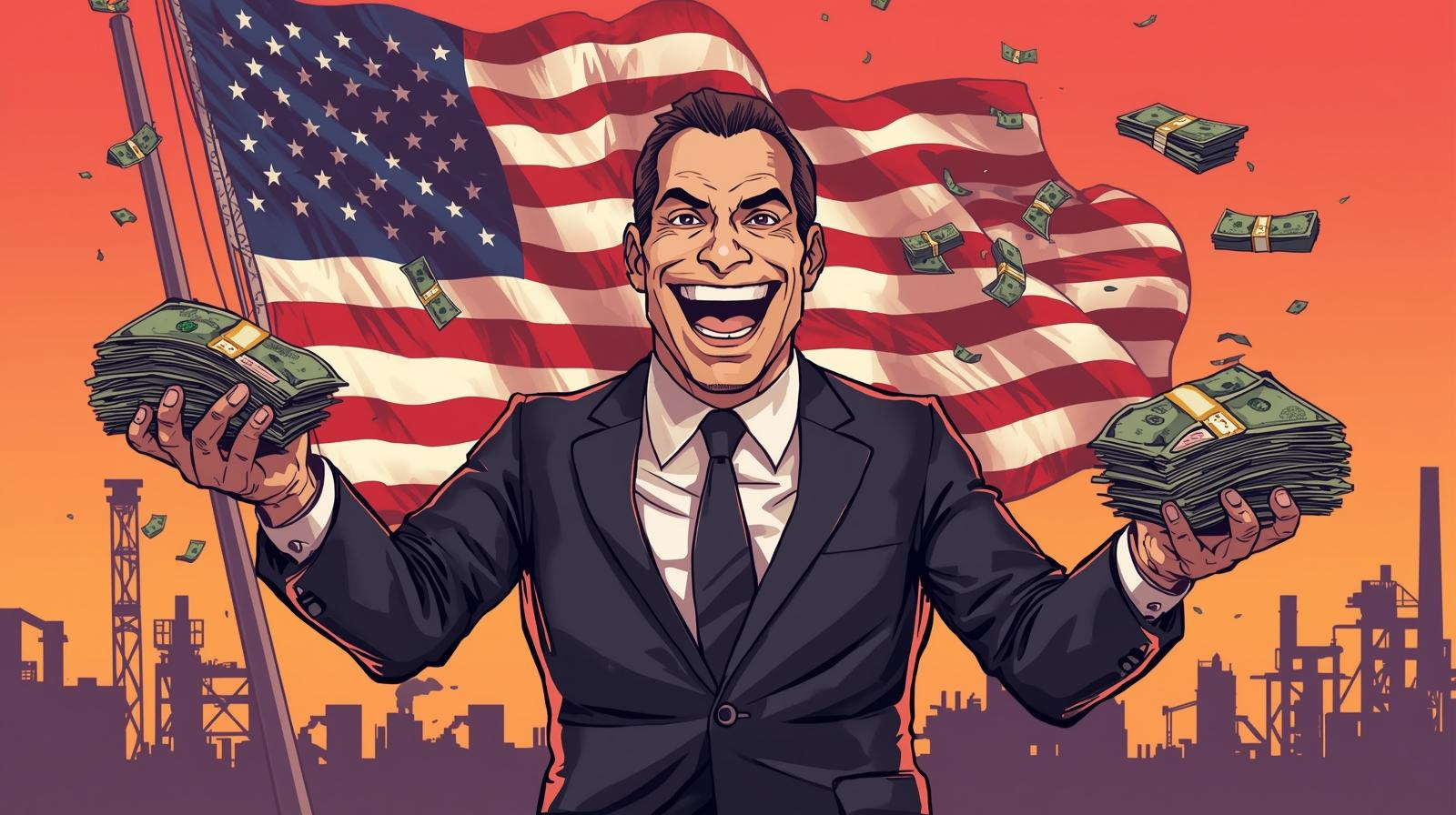

Stimulus as Spectacle: The Populist Betrayal of Productivity
Short-term cash, long-term cost: Why populist economics keeps selling the same dream — and why it always ends the same way.
The Promise That Sells Itself
When a president promises to hand every American $2,000, the crowd cheers. It feels like vindication—a reward for endurance after years of inflation, stagnation, and political noise.
But in the world of populist economics, the euphoria of free money always comes with a hidden receipt.
Donald Trump’s recent announcement of a “tariff dividend” — a payment to most U.S. citizens, supposedly funded by import tariffs — was designed to do exactly that. It’s patriotic, simple, and perfectly timed for an age of economic fatigue.
But peel back the headline, and what remains isn’t innovation. It’s economic theater — a recycled script where stimulus becomes spectacle, and populism sells temporary relief as genuine prosperity. This promise is the ultimate short-term fix, masking a deeper structural weakness in the economy, as The Wall Street Journal reported.
It’s not a new idea. From Argentina to Hungary, from Britain’s energy rebates to Japan’s stimulus coupons, governments have mastered the art of engineering applause with borrowed money.
And in each case, the aftermath looks eerily familiar: higher prices, weaker currencies, and disillusioned voters.
Artificial Prosperity: The Populist Formula
Every populist stimulus begins the same way: promise visible gains, hide invisible costs.
Whether it’s cash checks, energy subsidies, or a “tariff dividend,” the logic is seductively simple — someone else pays.
Trump calls tariffs “victories.” Economically, however, they are a tax on imports paid by domestic consumers through higher prices. The $2,000 “dividend” is, in effect, a refund of money Americans already paid at the checkout counter.
This comparison between political promise and economic reality is stark. According to estimates from the nonpartisan Congressional Budget Office (CBO) and the Tax Foundation, the policy functions as a tax that largely negates the very benefit it touts. The real impact is not wealth creation, but a transfer of economic friction directly to households across all income groups.
Cost Metric Source Estimated Impact Context Proposed Dividend (Political Promise) Political Promise $2,000 Annual Payment Real Annual Household Cost Increase Tax Foundation Up to $1,600 Projected by 2026 Aggregate U.S. Real Income Reduction Academic Study (JEP) $1.4 billion per month Due to 2018 tariffs
The trick works because it feels like free money, but it’s really relabelled taxation—a perfect example of salience bias in action: people notice a direct gain (a check), but not an indirect loss (higher prices).
This is artificial stimulus in its purest form — wealth reshuffled, not created. It gives the illusion of a boom without demanding any increase in productivity, efficiency, or structural reform.
As the old line goes: You can’t print innovation.
The Era of Engineered Growth
We now live in an economy of engineered outcomes. The dials are constantly being turned, by central banks, ministries, and political strategists, to simulate prosperity on demand.
Artificial market stimulus has many faces:
- Central banks cutting rates to zero to “revive” markets
- Governments sending checks to offset inflation they helped cause
- Leaders slapping tariffs on imports, then redistributing the proceeds
Each version tells the same story: pretend growth until morale improves.
In the short run, it works. Markets rally. Consumers spend. Approval ratings rise.
Even investors participate willingly — volatility drops, sentiment spikes, and the narrative becomes self-reinforcing.
But over time, the economy loses its immune system — a reality that makes recession-proof investing more vital than ever. And time, eventually, collects its debt. With interest, of course.
Populism as Economic Theater
Populism doesn’t just manipulate emotion — it monetizes it.
Trump’s tariff dividend fits a global pattern: Europe’s energy subsidies during crises, Japan’s yield-curve control, China’s property rescues.
Each is a performance designed to project control when fundamental economics weaken.
Populism thrives on visibility. It replaces the slow grind of productivity with the instant gratification of policy spectacle.
As economist Dani Rodrik observed, the measure of success is often not stability, but applause.
That’s the danger: policy becomes performance. The economy becomes a stage, and stimulus becomes a prop. And is not to fix, but to reassure.
Artificial prosperity is seductive because it’s visible — a transfer you can feel in your bank account.
Real, organic growth, by contrast, is often invisible: productivity gains, innovation, education, infrastructure. I’m sure you feel the difference.
The former wins elections; the latter takes decades.
And in today’s political calendar, decades are an unaffordable luxury.
The Hidden Costs of Cheap Thrills
Stimulus is a sugar rush for the economy. It’s instant, addictive, and inevitably expensive.
The dangers compound over time:
- Moral Hazard: Businesses and households stop preparing for downturns because they expect rescue.
- Distorted Markets: Prices reflect political expediency, not productivity.
- Inflation Feedback: Easy money and subsidies inflate the very prices they claim to fight.
- Fiscal Fragility: Deficits widen while voters believe they’ve been made richer.
“Artificial stimulus is financial anesthesia — it numbs the pain but doesn’t heal the wounds.”
It’s no coincidence that the most stimulus-heavy economies of the past decade — from the U.S. to Japan — now face record debt-to-GDP ratios. Growth, once unshackled by innovation, becomes dependent on intervention.
By the time the full effects fade, the leaders who implemented the policy are often gone. But a mess if left for the next administration and a society that now expects sugar on every downturn.
A Historical Echo
Ancient Rome had its panem et circenses (bread and circuses) to pacify the masses.
Twentieth-century Latin America had its cycles of subsidies, devaluations, and defaults.
Now, the developed world has found its own version: stimulus as a substitute for reform.
In the U.S., post-pandemic checks turned into inflation. In Europe, green subsidies ballooned deficits. In China, the property sector became a monument to moral hazard.
Each chapter ends the same way: an economy more fragile, not more fair.
Japan’s lost decades, Argentina’s subsidy addiction, and the 2020–2022 global stimulus-to-inflation spiral all share the same flaw — policy that replaces productivity with liquidity.
When the Music Stops
Artificial prosperity ends the same way it begins — suddenly. Interest rates will normalize, debt costs will surge, and finally consumer spending stalls. The illusion fades. The crowd that once cheered begins to ask where the money went — and the applause turns into blame.
The $2,000 promise might never even materialize. But its message lingers: that governments can outwit markets with optics, and voters can prosper without trade-offs.
Yet history shows the opposite — markets eventually reprice illusion, and voters eventually pay for spectacle.
The tragedy is that the real victims aren’t politicians or investors. It’s us, it’s ordinary citizens, who mistake temporary liquidity for lasting security.
The Real Dividend
If there’s one lesson to draw from this spectacle, it’s this:
“The only true dividend in any economy is productivity — the ability to create more value tomorrow than you did today.”
Tariffs, subsidies, and cash handouts can buy applause, but not resilience.
And in the long arc of economic history, populism always pays the same final dividend: disillusionment.
While developed economies chase stimulus headlines, Poland’s bull market reminds us that productivity and policy discipline remain the real engines of prosperity.
The question is whether societies can still tell the difference between a real paycheck and a political performance.
This article is for informational and educational purposes only. It does not constitute financial, investment, or legal advice.
All economic and financial policy discussions are presented for scenario analysis and illustration only. Investing involves high risk, and you may lose capital.
Always conduct your own independent research and consult a qualified professional before making any financial decisions.

Orbán Is Out. Has the Market Noticed Yet?