
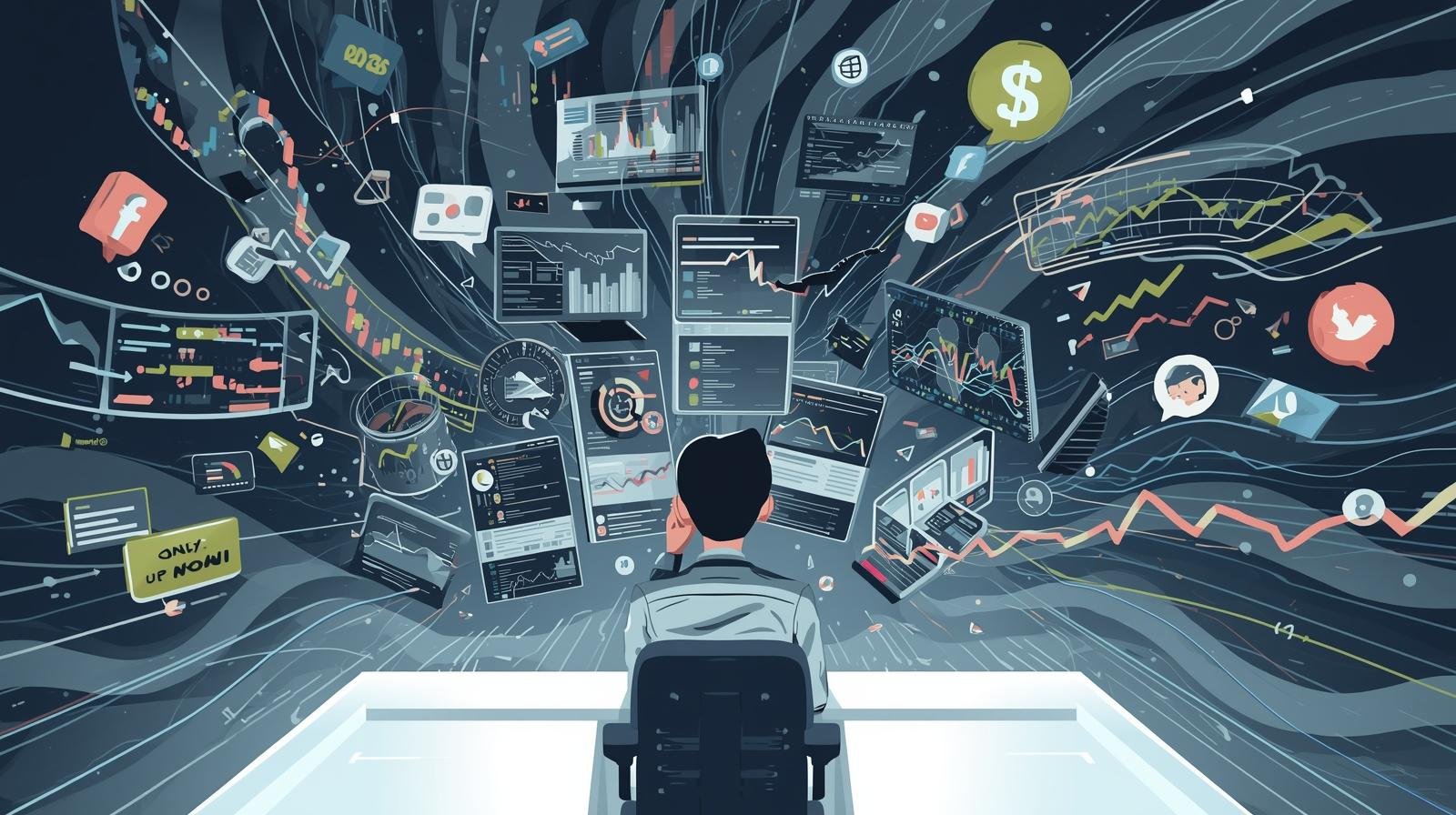

Markets were supposed to get smarter. With AI copilots summarizing speeches, alt-data scraping satellites, and dashboards lighting up in real time, investors finally had everything they’d ever wanted: instant knowledge. But in 2025, the smartest markets often act the dumbest. The firehose of information has outpaced the human ability to think.
The illusion of a smarter market
Every morning begins the same way. Screens bloom with alerts: overnight yield moves, CPI whisper numbers, a dozen versions of a Fed headline. Before coffee cools, sentiment models have already traded the text. The first half of the trading day is spent interpreting why the second half of yesterday’s rally reversed. The irony is painful—never have investors had more visibility, yet the collective view keeps narrowing.
At GreenCandlesHub we’ve watched this evolution from curiosity to crisis. Our earlier piece on the Fed’s psychological pivot argued that communication, not policy, now sets risk appetite. The data deluge has only deepened that shift. The modern market trades tone before numbers, reactions before facts, emotion before logic. It’s not ignorance—it’s excess.
When algorithms mistake speed for insight
Algorithms dissect every press conference and corporate call, assigning probabilities to phrases. If a policymaker swaps one adjective for another, a million-line script triggers in milliseconds. According to the Bank for International Settlements, more than a third of intraday volatility now stems from news-based triggers rather than fundamentals. Speed itself has become a trading strategy. The faster the data, the more confident the trade—and the shorter the conviction.
The result is what one strategist calls “quantitative superstition.” Machines no longer wait for confirmation; they trade the hint of confirmation. Human investors, trying to keep pace, anchor to the same micro-signals. A soft word from the Fed or a random CPI leak can set off a global repricing that unwinds hours later. The market still moves on fundamentals, but it reacts to syntax first.
From alternative data to amplified noise
The alternative-data revolution promised an edge: satellite imagery, online hiring ads, and credit-card swipes. Today, those streams are everywhere. Funds monitor car-park occupancy while retail traders buy dashboards offering “hedge-fund-level insight.” But when everyone stares at the same feeds, correlation replaces discovery. Data was supposed to reveal hidden patterns; instead, it created synchronized behavior that magnifies every small surprise. As we noted in Active ETFs and the Attention Economy, visibility has become the product itself.
The abundance of information does not level the field—it crowds it. The collective race for marginal signals produces what the BIS calls “information-driven reflexivity,” where every participant believes they see more than the next person but ends up following the same cues. Markets now trade the confidence interval, not the conclusion.
How the human mind collapses under infinite feeds
The human brain, evolved for scarcity, buckles under this abundance. Behavioral research from the CFA Institute reminds us that people handle a few variables well and the rest poorly. Give investors hundreds of flashing metrics and they default to emotion—anchoring to the last alert, confusing familiarity with truth, mistaking speed for accuracy. The new cognitive bias is not ignorance but exhaustion. Information fatigue breeds overconfidence, then paralysis.
The paradox of the digital market is that investors drown in numbers but starve for perspective. Knowledge decays into notification. A trader scrolling through fifty sentiment dashboards feels informed, but is really just sampling repetition. The more data points, the thinner the conviction.
The social feedback loop
Nowhere is this more visible than on X, the social arena once known as Twitter. The trading day there never ends. A handful of large accounts post endlessly bullish slogans—“Only up now,” “Uptober,” “Send it”—and each goes viral within minutes. Algorithms scrape the engagement metrics, feed them into sentiment trackers, and the cycle completes itself: optimism generates clicks, clicks register as sentiment, sentiment drives orders, and rising prices validate the original optimism. What begins as a meme becomes a market signal. When everyone’s timeline screams the same word, “bullish” stops being an opinion and turns into a self-fulfilling trade. Take a look on some example X posts:
Consider October’s crypto swings. As Bitcoin spiked a the flood of triumphant posts—screenshots, memes, “Uptober” chants—triggered a rush of leveraged buying. Within hours, funding rates hit unsustainable highs. The crash that followed wasn’t about fundamentals; it was about reflexivity, a theme we explored in Bitcoin’s October volatility lessons. What happened there is happening everywhere: structure overwhelms narrative, and emotion fills the gap.
Professional desks sometimes joke that the real FOMC minutes are written on X. Yet the joke hides an uncomfortable truth. Social feedback loops have compressed market mood into a handful of trending phrases. In 2025, a viral post from a trading influencer can push more volume through short-term futures than a minor economic report. Data overload makes markets reactive; social overload makes them delusional. Platforms designed for attention now function as the nervous system of risk appetite.
When algorithms trade each other’s emotions
This feedback culture would matter less if machines didn’t listen. But modern trading models scrape everything—headlines, posts, even emojis. When thousands of bots detect the same surge in “bullish” language, they respond before humans finish scrolling. What appears to be crowd enthusiasm is often a circuit of algorithms amplifying each other’s tone. Meta-volatility—volatility created by the expectation of volatility—now accounts for much of the market’s daily noise. It is no longer investors versus fundamentals; it is models versus models, reflex against reflex.
The hall of mirrors deepens the illusion of liquidity. Volume looks heavy because algorithms ping one another; depth looks real until it vanishes. Investors think they are reading market psychology when they are actually witnessing code-driven mimicry. The information age has become an echo chamber of simulated conviction.
The quiet return of slow money
Inside major institutions, a quiet counter-movement is forming. The smartest desks are getting slower. Some have reduced data subscriptions, rebuilt fundamental screens, and banned real-time alerts during policy events. They prefer to absorb the full context before trading, not chase every headline. A portfolio manager at a Nordic fund described his method to us as “digital fasting.” He reads central-bank transcripts the next morning, when the emotional dust has settled. His returns improved because his stress dropped. “The edge isn’t data,” he said. “It’s discipline.”
This discipline shows up in asset allocation too. The managers who beat benchmarks in 2024 and early 2025 didn’t predict every twist; they ignored most of them. They watched liquidity conditions, corporate margins, and policy tone—the three variables that still matter—while social sentiment swung wildly. Their secret wasn’t superior analytics but information hygiene: controlling what entered their mental models. As we wrote in Dollar Dominance, credibility remains the last scarce resource. Filtering noise is another way of preserving it.
Information hygiene as the new alpha
Information hygiene sounds dull but behaves like alpha. It begins with throttling inputs—no push notifications, scheduled review windows, deliberate silences before reacting. It continues with structured thinking: concise briefs instead of endless threads, explicit hypotheses before reading data, and checklists to counter hindsight bias. And it ends with curation. A short roster of primary sources—the BIS Quarterly Review, the IMF Blog, Morningstar fund flows, and a few trusted strategists—can outperform a thousand anonymous accounts shouting conviction without context.
The deeper lesson is psychological. Markets mirror our attention spans. When investors demand instant certainty, the system delivers instant volatility. When they allow ambiguity to breathe, prices discover value again. During the 2010s, information asymmetry created alpha; in the 2020s, attention asymmetry does. The investors who will survive this decade are not the fastest but the most selective—the ones who can tell the difference between a signal and a scream.
The culture of performance theatre
The transformation is cultural as much as technical. Finance used to reward patience and humility. Now it rewards performance theatre. A portfolio update framed as a meme gets more traction than a research note. The show becomes the strategy. Yet beneath the noise, capital still obeys fundamentals. Corporate profits, cash flow, and credit conditions continue to anchor valuations. Even the most algorithmic traders revert to those truths once the meme cycle exhausts itself. That is why long-term investors who cultivate calm—who step back from the data stream—often outperform during turbulent years.
Reclaiming agency in the age of overload
For readers managing their own portfolios, the takeaway is not anti-technology. It is about reclaiming agency. Use AI for organization, not obsession. Let dashboards summarize, but don’t let them dictate. Schedule information the way you schedule risk. If a headline demands an instant reaction, that is usually proof it deserves none. The market will offer infinite opportunities to panic, but very few to think. Take the latter.
In the end, information is like liquidity—useful when it flows, dangerous when it floods. As 2025 unfolds, investors will keep drowning in numbers that feel like knowledge. The winners will be those who learn to swim differently: slower strokes, fewer splashes, longer horizons. The best signal is still judgment. Everything else is just data.
This article is for informational and educational purposes only. It does not constitute financial, investment, or legal advice.
All economic and financial policy discussions are presented for scenario analysis and illustration only. Investing involves high risk, and you may lose capital.
Always conduct your own independent research and consult a qualified professional before making any financial decisions.





Trump’s 50-Year Mortgage Plan: The Brutal Math Behind It