


Meta closed a bet on autonomous AI agents when it bought Singapore-based Manus in late 2025 for roughly $2 billion to $3 billion by one source’s estimate. By January 2026 China’s Ministry of Commerce had opened a formal review. By March, the story was no longer “did Meta pay up for good tech?” — it was whether Beijing treats the transaction as a legal export of strategic AI capability built on the mainland, and what enforcement looks like when a holding company is in Singapore but the product lineage is Chinese.
What Meta Actually Acquired
Manus sells a general-purpose AI agent — software that plans and executes multi-step work (research, coding, workflows) with less hand-holding than a standard chatbot. The company traced to Chinese startup Butterfly Effect (Monica.im), later relocated headquarters to Singapore, and raised a $75 million round led by Benchmark, with Tencent and HongShan among backers, according to the same Reuters reporting cited above. Meta framed the purchase as fuel for consumer and business automation, including inside Meta AI.
Manus publicly claimed more than $100 million in annualized recurring revenue within months of launch — figures repeated across trade reporting. Whether that run rate holds through a regulatory siege is what equity holders must separate from the headline multiple Meta paid.
The strategic overlap with Meta’s existing AI spend is direct: Meta is already running a heavy capex cycle on models, data centres, and talent. Manus was supposed to compress time-to-product for agentic features in ads, business messaging, and developer tooling — not replace that cycle, but shorten paths inside it.
Why Beijing Treats the Deal as a Security File
In early January, China’s Ministry of Commerce said it would review Meta’s acquisition for compliance with export controls, technology transfer rules, and overseas investment regulations. Officials explicitly tied the case to AI talent and technology outflow after Manus’s move from China to Singapore. State media cast the acquisition near US$2.5 billion — close to the band Wall Street and wire services had used.
The legal theory is mechanical: even with a Singapore entity, if core development happened in China, regulators can argue the “export” of models, weights, and know-how to a U.S. buyer requires approvals they never granted. It is the same structural logic the U.S. applies to sensitive inbound deals through CFIUS — only here Beijing is asserting jurisdiction before IP and talent finish crossing the border.
From Review to “Singapore Washing”
By late March the narrative had hardened. CNBC reported that Beijing’s intervention shattered the idea that a Singapore flag alone could neutralise U.S.–China tension — what venture circles had labelled “Singapore washing.” The same piece said regulators barred co-founders Xiao Hong and Ji Yichao from leaving mainland China for Singapore, citing a Financial Times report, while Meta told CNBC the transaction complied with law and that it expected an “appropriate resolution.” Separately, CNBC cited people familiar saying more than 100 Manus staff had moved into Meta’s Singapore office in early March — integration proceeding while politics caught up.
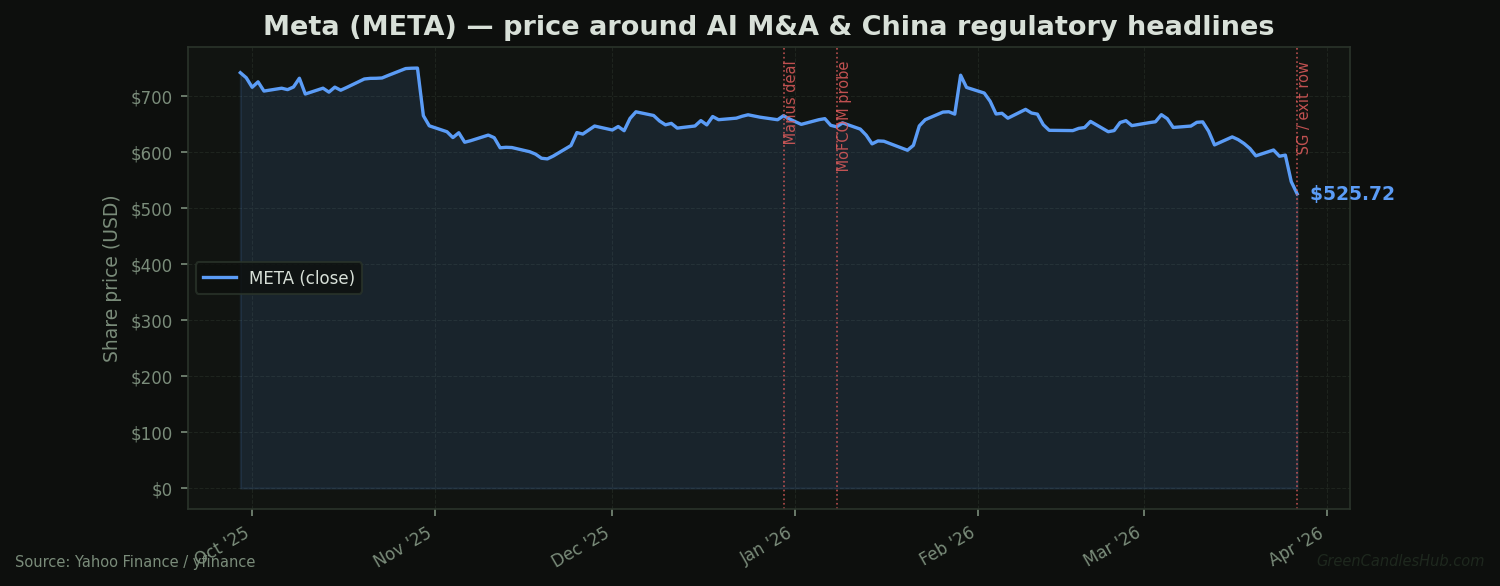
That split matters for traders: code and headcount can be in Singapore; regulatory risk can still sit in Beijing. China’s broader push to own strategic technology end-to-end makes this case a template, not an exception — any U.S. acquirer of China-originated AI will face the same question on where the “product” really lives.
How to Position on META
Price the option, not the press release. A completed deal announcement is not the same as a closed regulatory file. If MoFCOM extracts licensing walls — where models may run, what data leaves China, what must be retrained offshore — Meta still gets technology, but on a slower, costlier path than the ARR story implied.
Watch language, not vibes. The next catalysts are official statements from Chinese regulators, any filing language from Meta on contingencies, and earnings-call detail on Manus integration milestones. Silence is not neutrality; it can mean lawyers are negotiating conditions in private.
Think in second-order read-across. If Beijing forces restructuring or extracts permanent IP restrictions, every U.S. platform chasing Chinese-founded agent startups will bake a higher regulatory discount. Meta is the headline, but the trade is sector-wide policy risk on cross-border AI M&A.
Meta paid Silicon Valley multiples for speed in AI agents. The market is now pricing Beijing’s veto power over whether that speed survives contact with export law. For META, the trade is simple: treat Manus like a staged closing — and size positions accordingly.
Disclaimer: This article is for informational purposes only and does not constitute financial advice. Nothing here should be taken as a recommendation to buy or sell any security or asset. Always do your own research and consult a qualified financial adviser before making investment decisions.